
Introduction
There are cities you visit, and there are cities that stay with you. George Town is the latter.
The capital of Penang island, George Town is a UNESCO World Heritage city that wears its history openly — in the pastel facades of its pre-war shophouses, in the smoke rising from its temple incense coils, in the sound of a muezzin call drifting past a Chinese clan house. It is one of the oldest British colonial settlements in Southeast Asia, and centuries of Malay, Chinese, Indian, Arab, and European influence have layered themselves into something completely unique.
But George Town is not a city frozen in amber. It has one of the most vibrant street art scenes in Asia, a specialty coffee culture that would hold its own in Melbourne or Tokyo, and a food scene so legendary that Malaysians from every corner of the country make the trip specifically to eat here. It is simultaneously a living museum and one of the most dynamic small cities in Southeast Asia.
A flight or ferry from Kuala Lumpur gets you here in under an hour. It deserves at least three days. Most people wish they had stayed longer.
Places to Visit
George Town UNESCO Heritage Zone — The entire inner city is a living heritage site, and simply wandering it is the best thing you can do here. The streets around Armenian Street, Lebuh Chulia, and Jalan Masjid Kapitan Keling are lined with some of the finest surviving colonial-era shophouse architecture in Asia. No map required — just walk, look up, and explore.
Khoo Kongsi — The most spectacular Chinese clan house in Malaysia, and arguably in the world. Built by the Khoo clan in the late 19th century, it is an extraordinary complex of pavilions, courtyards, and a richly decorated main hall adorned with intricate wood carvings, painted murals, and gilded dragons. Entry is affordable and absolutely worth it.
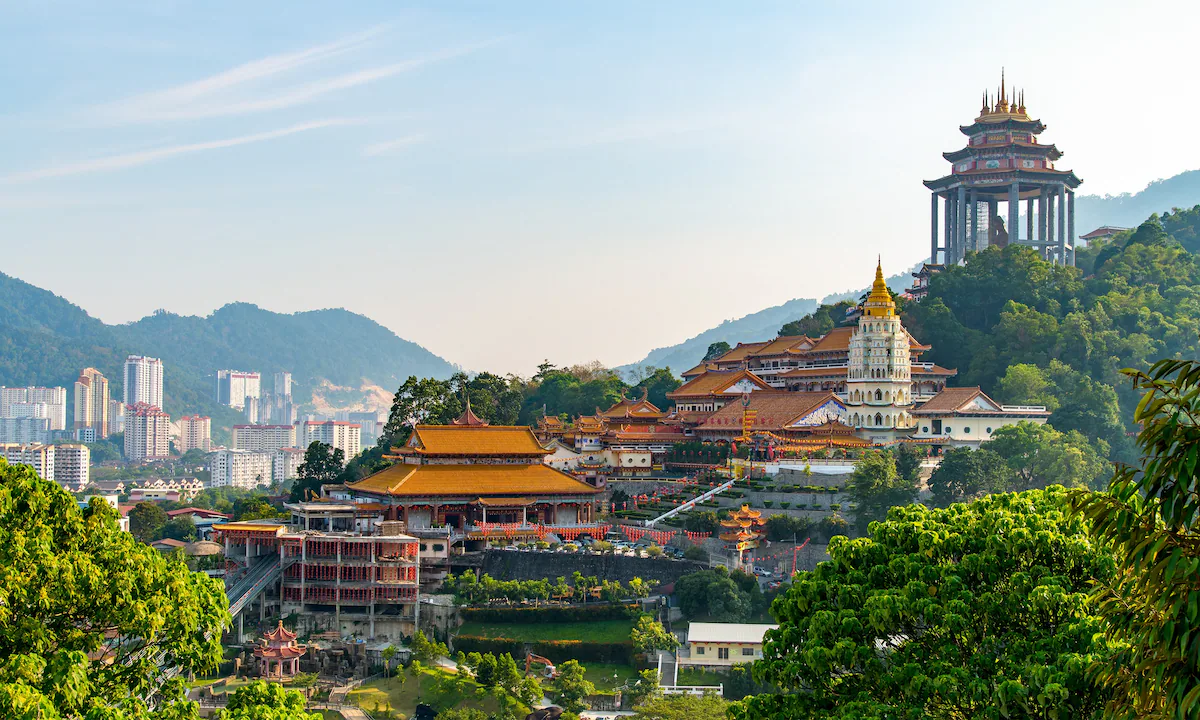
Kek Lok Si Temple — Perched on the hillside above Air Itam, Kek Lok Si is the largest Buddhist temple in Southeast Asia. The complex takes the better part of a morning to explore fully — ornate prayer halls, a seven-storey pagoda blending Burmese, Thai, and Chinese architectural styles, and a towering bronze statue of Goddess of Mercy that presides over the whole hillside. Go at dawn for the best light and fewest crowds.
Sri Mahamariamman Temple — One of the oldest and most vibrant Hindu temples in Penang, located on the heritage street of Jalan Masjid Kapitan Keling. The gopuram tower at the entrance is encrusted with hundreds of painted deities and is visually stunning. Remove shoes before entering and dress modestly.
Penang Hill (Bukit Bendera) — Take the funicular railway up to 833 metres above sea level for panoramic views across George Town, the strait, and the mainland. The hilltop is noticeably cooler than the city below, making it a welcome retreat. At the summit, The Habitat offers elevated canopy walks and guided nature experiences through the rainforest.
Fort Cornwallis — The oldest standing fort in Malaysia, built by Francis Light of the British East India Company in 1786. The original wooden fort was later rebuilt in brick and the cannons, ramparts, and lighthouse still stand. It sits at the northeastern tip of George Town, right on the waterfront.
Penang Street Art — George Town's outdoor street art began as a tourism initiative in 2012, when Lithuanian artist Ernest Zacharevic painted a series of murals depicting local children and scenes of everyday life directly onto the walls of heritage buildings. The most famous — "Children on Bicycles" on Armenian Street — became one of the most photographed images in Malaysia. A dedicated walking map is available at most guesthouses and tourism offices.
Little India (Lebuh Pasar) — A compact but intensely atmospheric district of sari shops, flower garland sellers, spice merchants, and Tamil restaurants. The streets burst with colour and sound, especially in the early morning when the temples are active and vendors set up their stalls.
Clan Jetties (Chew Jetty) — Ramshackle wooden villages built over the water by Chinese clans who settled here in the 19th century. Chew Jetty is the largest and most visited — a narrow boardwalk lined with homes, shrines, and souvenir stalls stretching out into the harbour. It offers a window into a way of life that has survived urbanisation largely intact.
Foods to Try
Penang Char Kway Teow — If you eat one thing in George Town, let it be this. Flat rice noodles wok-fried over blazing charcoal heat with prawns, cockles, Chinese sausage, egg, and bean sprouts. Penang's version is widely regarded as the definitive rendition in the world — darker, smokier, and more intensely flavoured than anywhere else. The charcoal wok is non-negotiable for the authentic version.
Asam Laksa — George Town's most iconic dish and a serious contender for the greatest bowl of noodles in Southeast Asia. Thick rice noodles swimming in a sour, tamarind-based fish broth, topped with shredded mackerel, sliced cucumber, pineapple, red onion, mint, and a dollop of thick prawn paste. It is pungent, complex, and unlike anything else. The stall inside Air Itam Market is considered by many to be the best in Penang.
Hokkien Mee (Prawn Mee) — A deeply savoury broth made by simmering prawn heads and shells for hours, served over yellow noodles and vermicelli with prawns, pork slices, hard-boiled egg, and kangkung. The broth is the star — rich, sweet, and intensely prawn-forward. Order it with extra sambal on the side.
Cendol — George Town takes cendol seriously. The Penang Road Famous Cendol stall near Jalan Penang has been serving its version since 1936 — shaved ice, pandan jelly strips, kidney beans, coconut milk, and generous amounts of dark, aromatic gula Melaka syrup. On a hot afternoon, there is nothing better.
Nasi Kandar — A Penang institution with Indian-Muslim roots. White rice served cafeteria-style and topped with your choice of curries, gravies, and proteins — fish, chicken, mutton, squid, okra, eggs — poured over one another until the rice is saturated. Line Clear in the narrow alley off Jalan Penang is the most famous nasi kandar spot in the city, operating since 1930 and open through the night.
Rojak — Penang's version of this fruit and vegetable salad is particularly beloved. Chunks of cucumber, pineapple, turnip, and fried dough are tossed in a thick, intensely savoury shrimp paste sauce with ground peanuts and sesame seeds. The sauce is the crucial element — dark, complex, and deeply umami.
Pasembur — Similar in spirit to rojak but with a distinct Mamak-Indian Muslim character. Crispy fritters, boiled potato, cucumber, turnip, and prawn fritters are piled together and drowned in a sweet, slightly spicy peanut sauce. A beloved street snack best found at the Gurney Drive hawker area.
Apam Balik (Turnover Pancake) — A thick, crispy-edged pancake filled with crushed peanuts, sugar, and sweet corn. The Penang version leans thick and cakey on the inside with a properly crunchy exterior. Available from street carts throughout the heritage zone throughout the day.
Penang White Coffee — Penang has its own white coffee tradition, distinct from Ipoh's. The kopitiam culture here runs deep — old coffeeshops with marble-topped tables, bare bulbs, and elderly proprietors who have been pulling the same coffee for fifty years. Sit down, order a kopi-o, and take your time.
Where to eat: Gurney Drive Hawker Centre is the most famous food destination in Penang — a long row of open-air stalls along the waterfront promenade serving almost every local dish until late at night. New Lane Hawker Centre (Lorong Baru) is less tourist-facing and equally excellent. For the deepest concentration of heritage food stalls, the streets around Jalan Penang and Lebuh Chulia in the morning are unbeatable.
Getting Around
Rapid Penang Bus — The island's public bus network is more comprehensive than most visitors expect. From the ferry terminal and Komtar bus hub in George Town, routes fan out to Batu Ferringhi beach, Kek Lok Si, Penang Hill, and beyond. Fares are very affordable, and the buses are air-conditioned. A Touch 'n Go card works across the network.
Grab — Widely available throughout Penang and the most convenient option for point-to-point travel, especially for reaching Penang Hill, Kek Lok Si, or the airport. Prices are fixed and transparent — no negotiating with taxi drivers.
Bicycle — George Town's heritage zone is compact and largely flat, making it one of the most pleasant cities in Malaysia to explore by bicycle. Rental shops are dotted throughout the heritage district, typically charging RM 10–15 per day. Cycling allows you to stumble upon murals, temples, and coffeeshops at your own pace — which is exactly how George Town should be experienced.
Trishaw (Beca) — Decorated trishaws are still actively used in George Town, both by tourists and elderly residents who have been riding them for decades. They are slow, charming, and the most atmospheric way to cover the heritage streets. Negotiate a price before you set off.
Ferry from the Mainland — If arriving by train to Butterworth on the mainland, the Penang Ferry across the strait to George Town is a classic experience in itself. The 20-minute crossing costs just a few ringgit and offers excellent views of the George Town skyline and the Penang Bridge as you approach. Ferries run frequently throughout the day and into the night.
Penang Bridge / Second Penang Bridge — If arriving by car or bus from KL, you'll cross one of two bridges connecting the island to the mainland. The Penang Bridge at 13.5km was once the longest bridge in Asia. Most express buses from KL drop passengers at Sungai Nibong terminal on the island, from which a Grab or local bus completes the journey to George Town.
Walking — The single best way to experience the UNESCO Heritage Zone. The core area between Fort Cornwallis, Armenian Street, the clan jetties, and Little India can be covered on foot in a day, though the heat demands regular stops for cold drinks and air-conditioning. Start early — by 8am if possible — before the afternoon heat arrives.
Insider tip: Stay inside the heritage zone itself if you can. Guesthouses and boutique hotels converted from pre-war shophouses put you within walking distance of the best food stalls, street art, and temples — and save you entirely from the question of how to get around in the morning when the best hawker stalls are operating and Grab demand is high.
Best Time to Visit
George Town is a year-round destination, but the months of December to February bring cooler, breezier conditions that make walking the heritage streets considerably more comfortable. The northeast monsoon brings occasional rain during this period, but rarely enough to disrupt a day of sightseeing.
July and August are dry and sunny, ideal for outdoor exploration and beach days at Batu Ferringhi, though these are also the busiest tourist months.
Chinese New Year transforms George Town into one of the most spectacular places in Malaysia to be — the heritage streets are lit with lanterns, lion dances move through Khoo Kongsi and the clan jetties, and the Chingay street procession draws enormous crowds. Book accommodation months in advance if visiting during this period.
Thaipusam (January or February) at the Sri Mahamariamman Temple is one of the most vivid and moving religious festivals in Southeast Asia — an experience that stays with you long after you leave.
Average daily budget: RM 150–300 (roughly USD 30–65) covers a comfortable heritage guesthouse, hawker meals throughout the day, museum entry fees, and local transport with ease. George Town remains one of the best-value travel destinations in the region for the quality of experience it delivers.
